
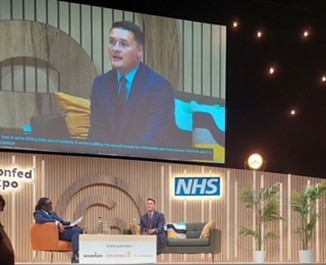
Joanna, our Partnerships Director at Warm Wales, attended the NHS Confed Expo 2025 in Manchester. The conference provided valuable provided valuable insights into the evolving landscape of health and wellbeing, particularly the role of volunteer organisations, primary care networks, and community health interventions. The discussions highlighted a pressing need for integration, trust-building, and holistic approaches to care.

A Whole-Person, Whole-System Response: Turning the Health and Work Crisis Into a New Future of Prosperity
In the UK today, over 2.8 million people are economically inactive and the most common reason? Their health. This isn’t just a statistic. It’s a signal that our systems health, work, and community are not yet integrated to support people living and working well.
At Confed Expo 2025, leaders from across sectors painted a clear vision: partnerships rooted in place, focused on people, and driven by the collective courage to act. The question is no longer why are so many people disengaged from the workforce, but how do we remove the barriers holding them back?
“Poverty annihilates the future” George Orwell
This resonant line captures the heart of the challenge. Health inequalities, work inequalities, and housing conditions are interwoven threads of a single tapestry. If we want to make our communities thrive, we have to start seeing people through a whole-person lens and redesign support to match.
Shifting the Dial Through Hyperlocal, Partnership-Driven Action
From Wrexham to Manchester, from Peterborough to Newport, we are seeing what’s possible when systems are designed with people, not just for them. No single intervention will deliver lasting change, but when we co-design services, integrate care, and apply local data with compassion, we see extraordinary impact.
“No wrong door” policies are ensuring people are never bounced between services, they’re guided to the right one.
Family hubs and place-based care are reaching children and parents before crises hit.
Voluntary sector connectors are becoming the vital bridge between the NHS and community, essential in reducing A&E attendances for both adults and children.
Integrated data systems, although a challenge, are showing promise in smarter care planning and proactive interventions.
Invest Now or Pay Later
Over 55,000 children are attending A&E unnecessarily—often due to unmet social needs, not clinical urgency. The financial argument is unmissable: for every £1 spent on upstream support, we save £3.05 in Tier 3 follow up support interventions. But the moral imperative is even stronger: we cannot afford to let poverty write a child’s future.
If the Future Is to Be Healthier, It Has to Be Local
Change must be deep, local, and co-owned. Whether it’s tackling child poverty in Cheshire and Merseyside or integrating social care in Deeside, the common thread is clear: it’s time to pool our interests, share our data, and focus on what really matters to the people we serve.
Because in the end, healthier children become healthier adults. And healthier adults rebuild healthier communities.
Integration as the Future
As the event wrapped up, the overarching sentiment was clear integration is the buzzword. But integration isn’t just about blurring lines of responsibility; it’s about shared responsibility. To build resilient, adaptable health systems, partnerships must embrace a holistic, person-centred model that truly meets people where they are.
Warm Wales, alongside other community-driven organisations, will continue to champion a wraparound approach, ensuring individuals facing complex challenges receive coordinated, accessible, and effective support. The future of healthcare lies in collaborative action and the insights from my time at the NHS Confed reaffirm that we are moving in the right direction.
To find out more about the work of Warm Wales or opportunities to work together, please contact Joanna Seymour Partnerships Director